Durability
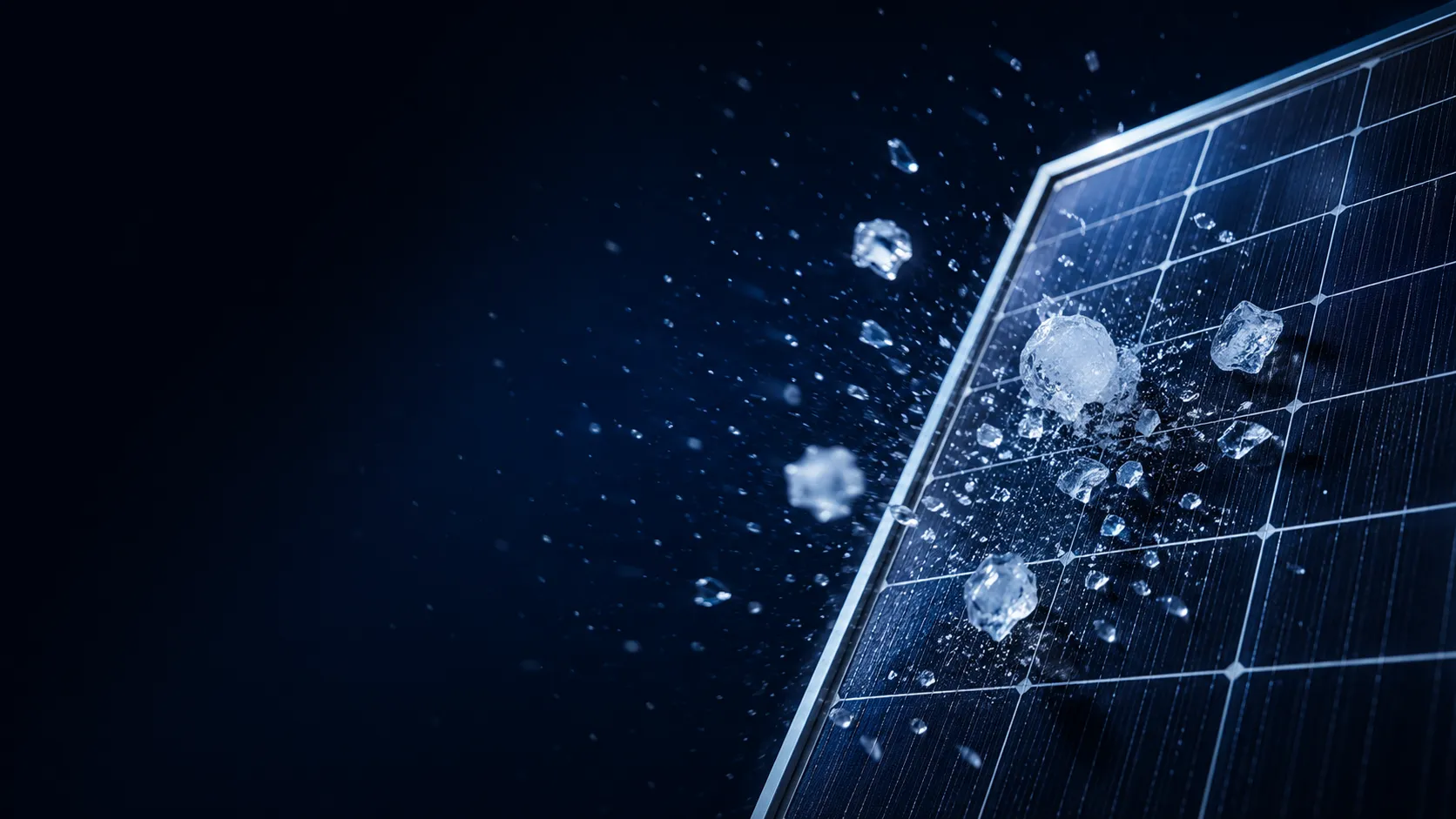
Solar panels made to stand up to hail.
Built for tough weather and backed by clear test results.
Tested beyond the standard
The standard test uses a 25 mm hailstone. Risen modules have been independently tested to 45.
The IEC 61215 standard tests a solar panel by firing a 25 mm ice ball at it at 83 km/h. Every certified module must pass. Every Risen module does. Risen modules have also passed independent third-party testing with ice balls up to 45 mm — about golf-ball size. Separately, Risen filmed a 600 W-plus 210 mm module taking two 35 mm heavy-hail hits on its vulnerable corners without leaving a mark. The certification and the 45 mm result are independent. The filmed test is Risen’s own internal R&D work, not a third-party certification.
- 25 mm
- Every Risen module passes the standard IEC 61215 hail test
- 35 mm
- Risen’s filmed internal R&D test — two hits to the corners with no marks
- 45 mm
- Largest ice ball used in independent third-party testing of Risen modules
- 5400 Pa
- Rated front load — about 550 kg per m²
Watch Risen’s internal R&D test
Two direct hits with no visible damage.
The China Meteorological Administration classifies hailstones larger than 20 mm as a heavy-hail event, a serious hail disaster level. Risen’s R&D team aimed at the vulnerable corners of a 600 W-plus 210 mm module. They fired two lab-grown ice balls, one after the other, using the IEC 61215 method: 34.40 mm at 27.95 m/s, then 35.10 mm at 26.34 m/s. The module had no cracks or marks after either impact. This was Risen’s own internal R&D test using the IEC 61215 method. It was not a third-party certification.
IEC 61215 hail test
What the hail test measures.
Each test ice ball has a set diameter, mass and impact speed. The 25 mm ball is used for the standard qualification test. Larger sizes are used for enhanced tests. Impact energy rises quickly as the ball gets bigger. A 45 mm ball, about golf-ball size, hits with roughly ten times the energy of the standard test. That is why testing beyond 25 mm matters.
| Hailstone diameter | Mass | Impact speed | Size comparison |
|---|---|---|---|
| 25 mm Standard test | 7.53 g | 23.0 m/s (83 km/h) | Marble |
| 35 mm | 20.7 g | 27.2 m/s (98 km/h) | Large marble |
| 45 mm | 43.9 g | 30.7 m/s (110 km/h) | Golf ball |
| 55 mm | 80.2 g | 33.9 m/s (122 km/h) | Billiard ball |
| 65 mm | 132.0 g | 36.7 m/s (132 km/h) | Tennis ball |
| 75 mm | 203.0 g | 39.5 m/s (142 km/h) | Baseball |
Source: IEC 61215 hail-test settings for ice-ball diameter, mass and test speed, ±5%. Every Risen module is independently certified against the 25 mm test. Risen modules have also passed independent third-party testing at the 45 mm size. Risen’s separate filmed internal R&D test uses the 35 mm size and is not a third-party certification.
Built for strength
How Risen panels are made to handle hail.
- 01
Heat-strengthened glass on both sides
Risen’s flagship bifacial modules use two panes of 1.6–2.0 mm heat-strengthened glass, one on the front and one on the back. The glass also has an anti-reflective coating. Unlike a soft polymer backsheet, the second glass pane adds strength and helps spread the force of a hail strike.
- 02
Rated for a 5400 Pa front load
The frame and glass are rated for a 5400 Pa front mechanical load. That is roughly 550 kg pressing on every square metre. This strong, rigid structure handles snow and wind loads with less flex and helps resist a concentrated hail strike.
- 03
n-type cells with more power pathways
Risen’s n-type TOPCon and heterojunction (HJT) cells use many fine connections, known as multi-busbar and 0BB designs. These give electricity more pathways around a small local crack. This helps the module keep producing power after an impact that could interrupt a cell with fewer connections.
- 04
Clear, proven test results
Every Risen module is independently certified to IEC 61215 and IEC 61730. These international durability and safety standards include a hail impact test. Risen modules have also passed independent third-party testing with ice balls up to 45 mm. Separately, Risen’s own R&D lab filmed two 35 mm heavy-hail ice balls striking the vulnerable corners of a 210 mm module, one after the other, without leaving a mark. The certification and 45 mm result are independent. The filmed test is Risen’s internal R&D test, not a third-party certification.
FAQ
Hail & durability — common questions.
Are Risen solar panels hail resistant?
Yes. Every Risen module is independently certified to IEC 61215 and IEC 61730, which include a hail impact test. Risen modules have also passed independent third-party testing with ice balls up to 45 mm — about golf-ball size. In a separate internal R&D test, Risen filmed two 35 mm heavy-hail ice balls hitting the corners of a 600 W-plus 210 mm module without leaving a mark. The 45 mm result is independent. The filmed test is Risen’s own internal work, not a third-party certification. Heat-strengthened dual glass and a 5400 Pa mechanical load rating help Risen panels stand up to Australian hailstorms.
What size hail can Risen solar panels withstand?
Every Risen module passes the IEC 61215 qualification test. It fires a 25 mm ice ball at the panel at 23 m/s (about 83 km/h). Risen modules have also passed independent third-party testing with 45 mm ice balls — about golf-ball size. Separately, Risen’s own filmed internal R&D test fired two 35 mm ice balls, one after the other, at the vulnerable corners of a 600 W-plus 210 mm module. This is heavy hail under the China Meteorological Administration’s definition. The module was unscathed. The 45 mm result is from independent third-party testing. The filmed 35 mm test is Risen’s own internal test, not a third-party certification.
What is the IEC 61215 hail test?
IEC 61215 is an international durability standard for solar modules. The hail test fires carefully made ice balls at 11 impact points on the panel. The standard qualification uses a 25 mm ball at 23 m/s (83 km/h). The panel must have no visible cracks and must keep working as required. IEC also sets out larger ice-ball sizes, up to 75 mm, for enhanced testing. Risen modules have been independently tested to the 45 mm size. The 35 mm size was used in Risen’s separate filmed internal R&D test, not a third-party certification.
Are dual-glass panels more hail resistant than glass-backsheet panels?
Generally, yes. A dual-glass module has toughened glass on both sides, instead of glass on the front and a soft polymer sheet on the back. The second pane makes the module more rigid and helps spread the force of an impact. That is why dual-glass products, including Risen’s Hyper-ion Pro and n-type TOPCon bifacial modules, tend to handle hail and heavy loads better.
Which Risen panel is best for a hail-prone area?
Risen’s bifacial dual-glass modules are the strongest choice. Options include the high-performing Hyper-ion Pro HJT (RSM132), as well as n-type TOPCon bifacial modules for homes and commercial roofs. They all use heat-strengthened dual glass and have a 5400 Pa front load rating. Talk to our team about the right module for your property and local hail risk.
Is hail damage to solar panels covered by warranty?
A product warranty covers manufacturing defects, not storm damage. Hail damage is normally handled through home or business insurance. Choosing a module that meets IEC 61215 and IEC 61730 and has been tested beyond the standard can reduce the chance of damage. Its certification also helps show that the solar system was built to standard. Risen modules come with a 15–25 year product warranty and a 30-year performance warranty, with local service in Australia.
Planning solar in a hail-prone area?
Explore our n-type TOPCon and Hyper-ion HJT dual-glass modules, or ask our team which option suits your property.